This Michelin 2-star restaurant is located in H Queen's in Central, on the top floor of the building. Knowing that Chef Maxime Gilbert is renown to make use of Japanese ingredients to develop his recipes of modern French cuisine, we came with a high expectation, and happily the whole experience turned out even better than I originally hope.
The name itself was a French word meaning scripture, and stepping out the lift we found the bookshelf decor interesting and echoing that. Greeted warmly by the staff, we were seated at the window side, looking out into the skyline of the Central district. The walls are painted with coppery veins, matching the symmetric copper ceiling tiles, offering a comfortable, chic and stylish environment. The tables are set with a fair distance apart, allowing good privacy for conversations. The chairs are also contemporary and overall one could feel the attention the restaurant had placed in creating a nice dining atmosphere.


We decided to go for the Library of Flavours tasting menu ($1788 each). And quickly we were served an array of Amuse Bouche. Everything were very delicate, beautifully rendered, and tasty. The staff also explained each of them to us, but with my poor memories I failed to recall exactly so I did not attempt to try review them here. I was quite positively surprised by both the quantity and quality of everything, pairing well with the glass of Perrier-Jouet Belle Epoque Rose to start.


The first course was Moshiba Tomato and Katsuo. The grilled bonito are placed on appealing, brightly red slices of tomato and strawberry. Both the tomato and strawberry came from Japan, with the tomato having an intense taste, with great balance of sweetness and acidity matching perfectly with the Amaou strawberries from Fukuoka, and having both marinated in olive oil. The katsuo, or bonito, are grilled nicely, with crispy skin, the meat soft and tender. On the side the chef also used the bonito shavings and put on a toast which is truly amazing. A great start for the menu, and it was paired beautifully also with Domaine Bellaud Vin de Savoie Le Feu.


The second course was Caviar Tart. This is an additional course which diners can opt for, with an supplement charge. A signature of the restaurant, I found almost all the customers did order this, and it was good that I followed suit. Great in presentation, the tart is full of royal cristal caviar on top, with the caviar nice in size, bursting with creamy aromas and long after-taste. The fillings have Hokkaido sea urchin which matches well with the caviar. The tart crust is also beautifully baked, with some Bearnaise sauce to accompany. A must-order in my opinion, the wine paired was a very nice Champagne Thienot Cuvee Stanislas Blanc de Blancs.

The third course was Kagoshima Bamboo, roasted with honey and vanilla, with a yogurt sauce and black truffle on top. A very interesting dish, the bamboo has a sweet and subtle taste that goes very well with the yogurt sauce. The truffle shavings on top further adding some more complexity to the dish. The wine paired was a very nice wine from Cotes du Jura, Domaine Ganevat La Pelerine, and I found the Savagnin matched perfectly with the bamboo.

The fourth course was Butternut, which is cuttlefish mille-feuille with chestnut sabayon. The cuttlefish is sliced into thin strips and then put back together to make the mille-feuille, and without looking at the menu I would have no clue what this dish is. There are a nice grill on the edge, with the creamy sabayon exhibiting a rich chestnut flavor, plus the sprinkles of small crunchy pieces, accompanied very well with the cuttlefish. Switching from France, the wine paired was from Italy Friuli region, Ronchi di Cialli Colli Orientali del Friuli Cialla, with good green fruit and flinty notes.

The fifth course was another innovative creation leveraging Japanese ingredients with a HK element. The staff first came to the table-side with a cast-iron pot. The Akamutsu, the premium black-throated sea perch from Japan, was wrapped in Kombu from Britanny with Verbena. The staff poured in a portion of sake over hot stones, before closing the lid to allow the fish to get steamed for 3 minutes (timed by a hourglass). The fish was tender, intense on the original flavors and seasoned delicately from the kombu leaves wrapping, without further herbs or other things to interfere the taste except a broth made from the fish bones. Fantastic for someone who like the fish, it has a great pairing with the sake produced by Fukuoka winery Miinokotobuki.

The sixth course was something quite rarely used by restaurants in HK, Veal Sweetbread. It is in fact the throat glands from veal, with a soft texture that somehow reminds me a bit on the brain or fish milt. The chef had cooked au sautoir, over a frying pan to brown it on the outside to caramelize while retaining the creamy and soft interior. On the side there is the kuro awabi ragout. The stewed black abalone are cut into small pieces, highly flavorful and a very innovative matching with the sweetbread. With Chateau de Fosse Seche Reserve du Pigeonnier from Loire, the Cabernet Franc blend paired very well with the food in a classical manner.


The seventh course was the main course and there are two choices, with me going for Roasted Blanc de Blanc Lamb while my wife had the Miyazaki A5 Wagyu with Black Truffle. The lamb is really tender, cooked to medium-rare with the fat trimmed. The lamb did not have any gamey note also so one don't need to worry even if you do not like that. And apart from the rack, the chef also prepared a rice by shredding the meat and then adding chives and mushroom, which honestly I like even more than the lamb itself. I did not try the beef but my wife enjoyed it very much too. For the wine the Domaine Heitz-Lochardet Pommard 1er Cru Les Rugiens matched perfectly with the gamey and mushroom characters reinforcing with the dish harmoniously.

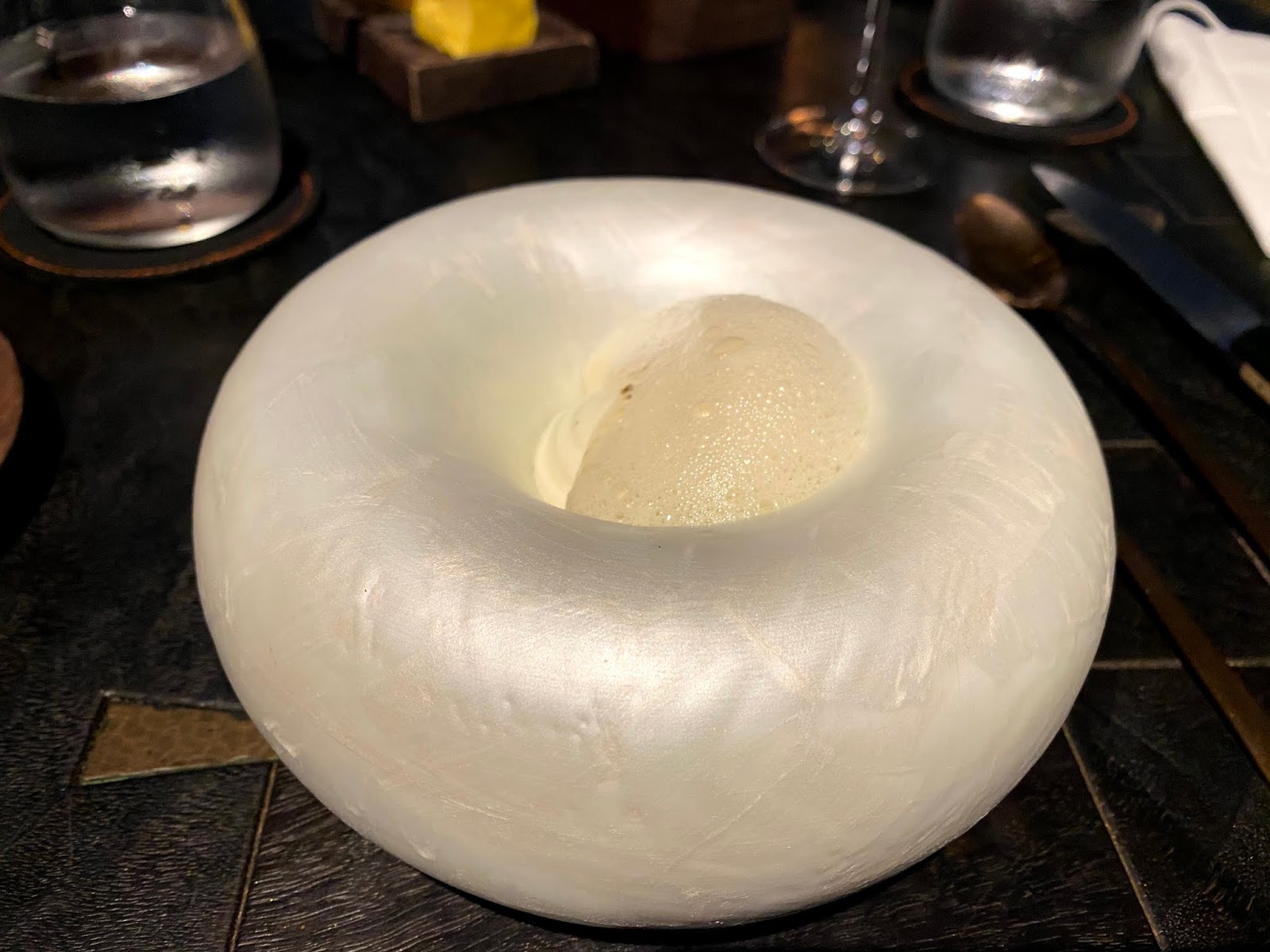
For dessert, the first one was Quince, which is cooked in hibiscus bouillon, confiture of plum preserve in vinegar. Light and with acidity, it served also as a cleanser to our palate. The wine paired was a big surprise the sommelier brought me something really special. The wine is a distill coming from Fleurs de Sureau. A bit higher on alcohol, the intense floral notes matches well with the acidity and sweetness of the dish.
For the last course, my wife chose Pear, the opalys white chocolate ganache and nuts feuillantine, while I had the Hay adn Black Truffle, with cream and ice-cream, puff pastry with onion crisps. The crisps are truly innovating, with them deep-fried and so did not even any unique smell. The generous black truffle shavings on top provided not just a contrast in flavors, but also on texture. A good way to wrap up the dinner, and the wine paired was a Vouvray Moelleux from Foreau.
Throughout the night the staff came repeatedly to check in with us, and when every dish was served the staff also took the time to explain to us that we would be eating. Removing a lot of anxiety... There are Petits Fours with Melon, a Baked Cheese Cake, and a Chocolate Tart. Everything were good, with the fruit fresh and juicy, while the other two dessert also appropriately sweet and intense on the palate.
The bill on the night was around $4,000 (for two). A reasonably priced menu considering the number of courses, quality of the ingredients, and the overall experience. The wine pairing was very good, and not because of the wide range of choices, but also how Vincent can pinpoint the special flavor profiles. I would definitely come again...
 Ingredients (for 4):